From June 26 to 28, 2026, the 2026 Tongji University Symposium on Frontiers in Scientific Computing was successfully held at Lecture Hall 108, Zhiyuan Building, School of Mathematical Sciences, Tongji University. The symposium was jointly hosted by the School of Mathematical Sciences of Tongji University, the Key Laboratory of Intelligent Computing and Applications of the Ministry of Education, and the Shanghai Frontier Science Research Base for Intelligent Computing. Professor Xu Xuejun, Vice President of Tongji University and Director of the Key Laboratory of Intelligent Computing and Applications of the Ministry of Education, attended the symposium and delivered a speech. Researcher Zhao Guiping from the National Natural Science Foundation of China presided over the opening ceremony and also delivered remarks.
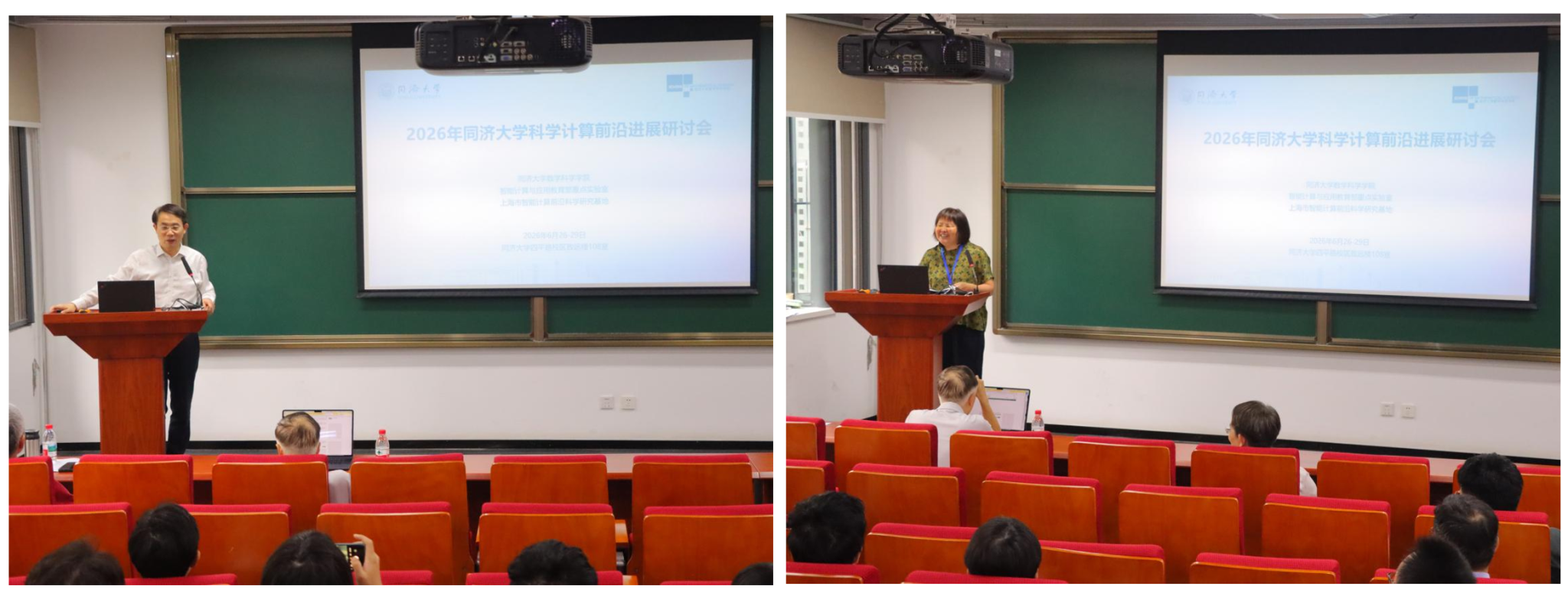
At the opening ceremony, Vice President Xu Xuejun reviewed the development history of the discipline of mathematics at Tongji University, introduced the progress the university has made in mathematics discipline development, talent recruitment and research platform building, and underscored the foundational role of mathematics in the university’s development and in scientific and technological innovation. In her remarks, Researcher Zhao Guiping reviewed the developments and changes in the field of scientific computing in recent years, noting that scientific computing serves as a vital bridge linking mathematical theory, computer science and engineering applications. Against the backdrop of rapidly advancing artificial intelligence, she analyzed the profound impact of AI on mathematics teaching, scientific research and talent cultivation, and shared her reflections on how mathematics researchers can seize the opportunities presented by disciplinary transformation, drive innovation in research paradigms, and strengthen the deep integration of mathematics with engineering technology.
The symposium brought together distinguished experts from universities and research institutes across the country, including Professor Hu Jun from Peking University, Researcher Ming Pingbing from the Academy of Mathematics and Systems Science of the Chinese Academy of Sciences, and Professor Shen Jie from Ningbo Eastern Institute of Technology.
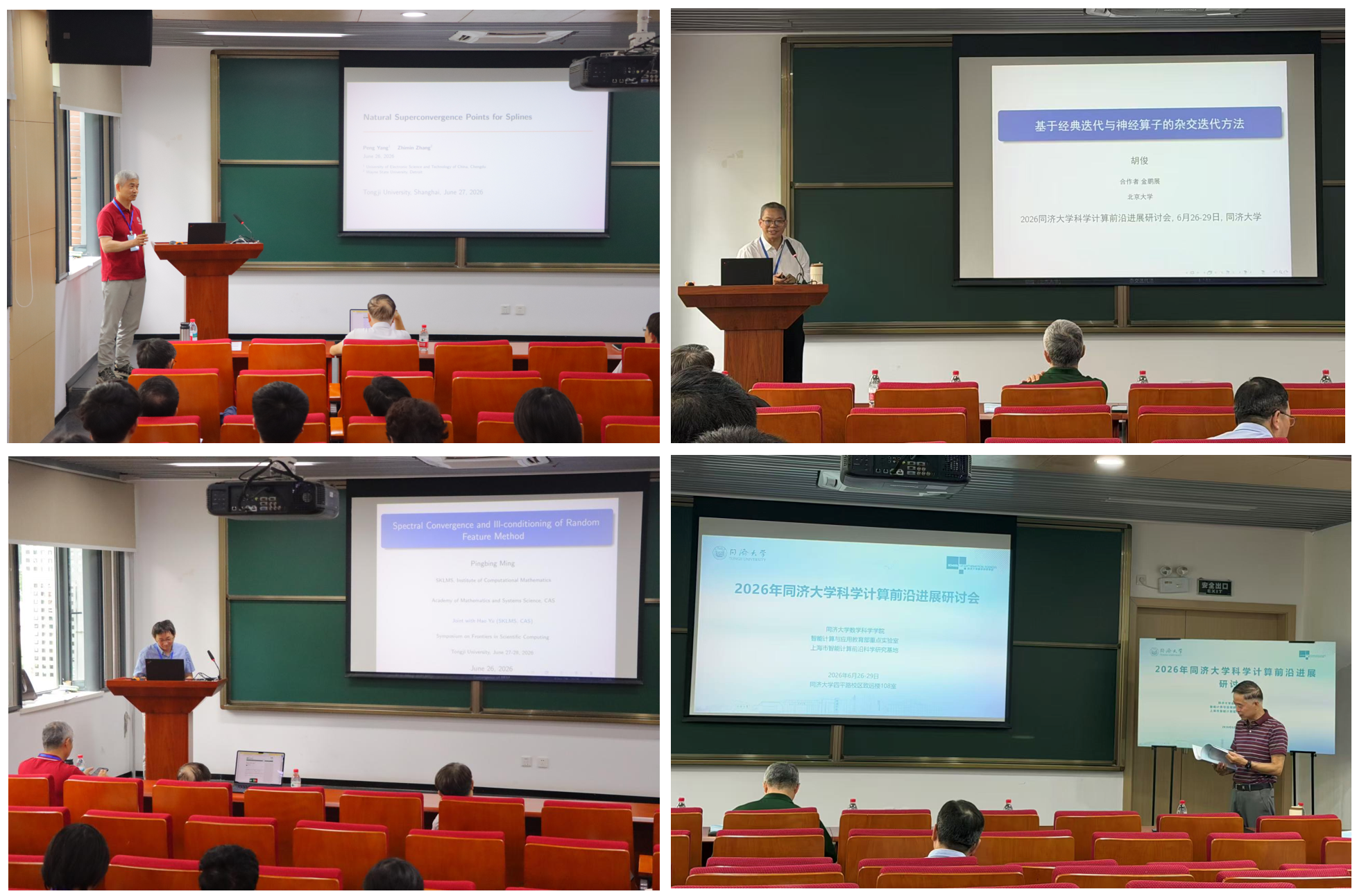
The participating experts delivered excellent presentations and held in-depth discussions on a range of frontier topics, including natural superconvergence points of splines, convergence and superconvergence of random feature methods, hybrid iterative methods based on classical iterations and neural operators, as well as machine learning force fields and large material models, CAE-CAD integration, wave scattering in layered media, finite element methods for interface problems, quantum preconditioning algorithms, structure-preserving discretization for incompressible flows, the JKO scheme for gradient flows, and the learning of unknown differential equations. Featuring frontier themes and rich content, the presentations showcased the latest advances in the fundamental theory and numerical methods of scientific computing, while also demonstrating the significant application value of computational mathematics in such fields as materials science, fluid mechanics, wave propagation, industrial simulation and artificial intelligence.
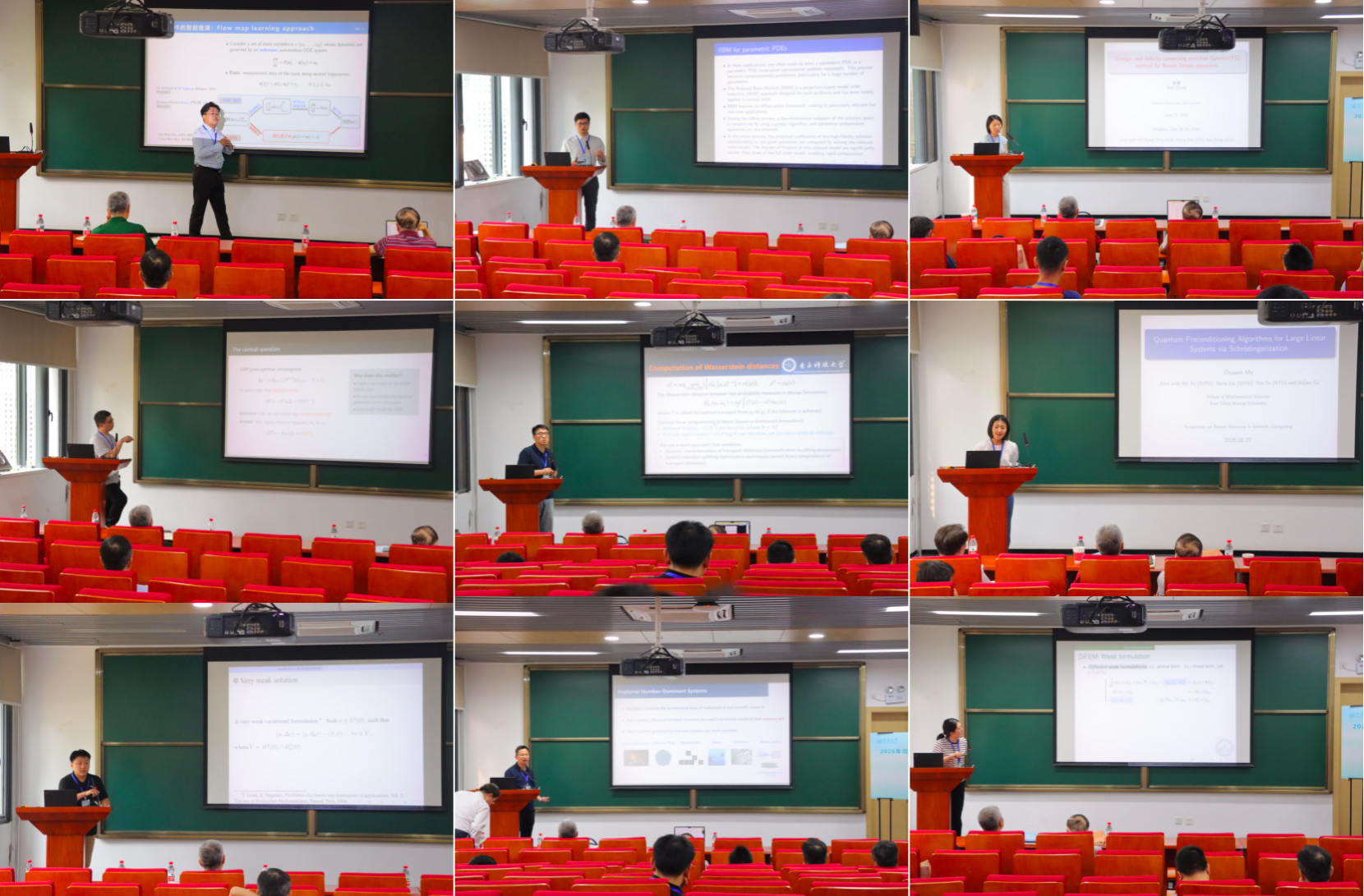
The successful holding of this symposium provided a valuable platform for exchange and collaboration among experts and scholars in the field of scientific computing, further promoted cross-fertilization across different research directions, and strengthened academic ties among domestic universities and research institutes. It also gave a helpful boost to the coordinated development of the theory, algorithms, software and applications of scientific computing, and to innovation in intelligent computing and related interdisciplinary fields.
 中文版
中文版

 Official wechat