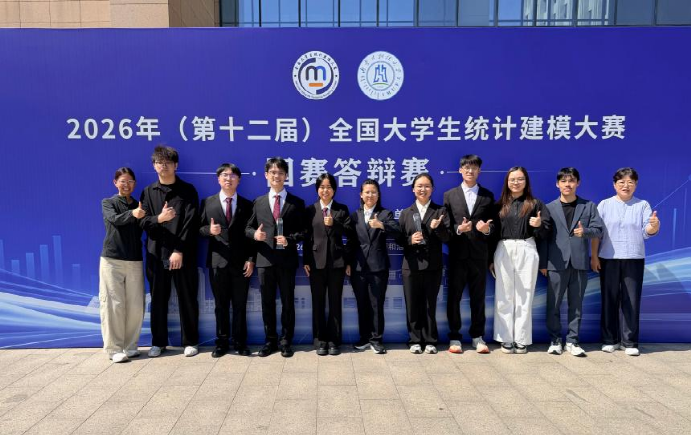
The on-site defense round of the 2026 (12th) National College Student Statistical Modeling Competition recently concluded successfully at Inner Mongolia University of Finance and Economics. Following university-level selection, Shanghai regional selection, national-level correspondence review, on-site evaluation and defense, Tongji University students — with their solid statistical literacy, innovative modeling thinking and outstanding teamwork — won two national first prizes, three second prizes and four third prizes, ranking first among all institutions in the Shanghai region. The first-prize team in the graduate category came from the College of Transportation Engineering, and the first-prize team in the undergraduate category came from Guohao Academy.
Introduction to the First-Prize Projects
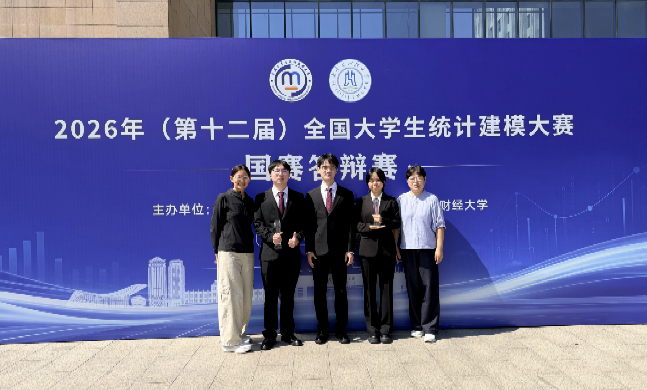
Graduate Category — First Prize
Project Title: Sparse Video Data-Driven Holographic Reconstruction of Road Vehicle Trajectories and Congestion Prediction
College: College of Transportation Engineering
Team Members: Jin Zhengmiao, Kuang Zhenglin, Li Yiling
Faculty Advisor: Liu Haobing
Project Overview: In small and medium-sized cities, insufficient sensor coverage and sparse traffic observation lead to discontinuous vehicle trajectories and make congestion prediction difficult. To address this, the team built an analytical framework of “discrete data — trajectory reconstruction — indicator construction — congestion prediction” based on electronic police (e-police) vehicle passage data. By improving trajectory reconstruction and extracting traffic state indicators such as road segment flow and vehicle density, and by integrating spatiotemporal features to carry out congestion prediction, the study provides a feasible path toward low-cost traffic sensing, congestion early warning and refined urban traffic governance for small and medium-sized cities.
Undergraduate Category — First Prize
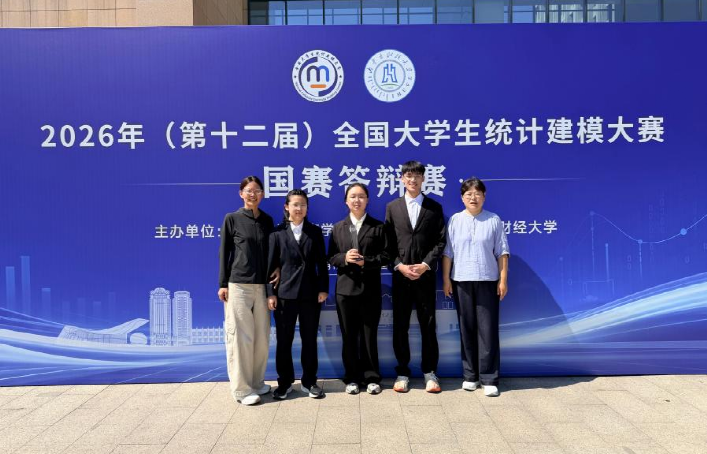
Project Title: “Data” Connects Capacity, “Intelligence” Solves Mobility — Research on Integrated Spatiotemporal Supply-Demand Prediction and Dispatching of Ride-Hailing Services for Precise Capacity Allocation from a Smart City Perspective
College: Guohao Academy
Team Members: Ran Jialei, Liu Yang, Gong Jinxiao
Faculty Advisor: Su Zicheng
Project Overview: In recent years, the ride-hailing industry has expanded rapidly and urban travel demand has grown steadily. Yet the mismatch between vehicle supply and demand during peak hours has become increasingly acute, with capacity shortages existing alongside vehicles running empty. The team introduced a decision-oriented intelligent prediction framework that creates a closed-loop feedback between prediction and dispatching: dispatching returns are used to guide the training of the prediction model in reverse, enabling proactive pre-deployment of ride-hailing capacity before peak hours arrive. The approach effectively alleviates regional supply-demand imbalances, improves platform operational efficiency, and offers a solution for the refined allocation of ride-hailing capacity in smart cities.
Grounded in national strategies and the practical needs of urban development, the two first-prize projects closely integrate statistical modeling with concrete scenarios such as traffic operations and platform dispatching. They fully demonstrate Tongji students’ innovative ability to identify problems with data, analyze problems with models and solve problems through practice, and reflect the solid results of the university’s interdisciplinary, collaborative approach to education.
The National College Student Statistical Modeling Competition is hosted by the China Statistical Education Society and is listed among the nationally recognized college student competitions. Guided by the theme “Serving National Strategies, Innovating with Statistical Empowerment,” this year’s competition drew 18,727 teams from 909 institutions into the regional rounds. After rigorous selection at every stage, 897 teams advanced to the national round, of which 150 progressed to the on-site defense to compete for national first prizes and some second prizes.
The Shanghai regional round of this year’s competition was hosted by Tongji University, with the School of Mathematical Sciences leading the organization of the university-level contest. Since the competition launched in March, university leadership, the school and the entire faculty and student body have attached great importance to the event and given full support to its preparation and organization. The School of Mathematical Sciences assigned its strongest staff to form a regional-round working team; all members took initiative and worked with a strong sense of responsibility, completing every task with a rigorous and meticulous approach and ensuring the smooth conduct of the Shanghai regional competition. The school’s faculty team sustained their involvement across competition organization, information and material review, university-level selection, specialized training and contest preparation services, building a professional and systematic support platform for participating students and effectively pooling statistical education resources from both within and beyond the university. The school also launched the “2026 Statistical Analysis Training Camp,” providing end-to-end coaching on core modules including topic selection, models, algorithms, papers, charts and presentations. Associate Professor Yang Xiaohan of the School of Mathematical Sciences delivered a practical lecture on statistical modeling and academic writing for contestants, helping students strengthen their capabilities in data analysis, model construction and the presentation of results.
Looking ahead, the School of Mathematical Sciences at Tongji University will continue to play a leading role in organizing statistical modeling competitions and providing professional guidance. Drawing on its distinguished faculty, training platforms and interdisciplinary education mechanisms, the school will further deepen the reform of statistics education, encourage more students to take part in academic competitions and research practice, and cultivate more high-caliber talent with a solid mathematical foundation, an innovative mindset and strong practical ability — contributing Tongji’s wisdom to the service of national strategies and high-quality economic and social development.
 中文版
中文版

 Official wechat